
Chloride SCC threshold
Austenitic stainless steels can be susceptible above about 60 deg C / 140 deg F with tensile stress and chloride exposure
Stainless steel / UNS S31603
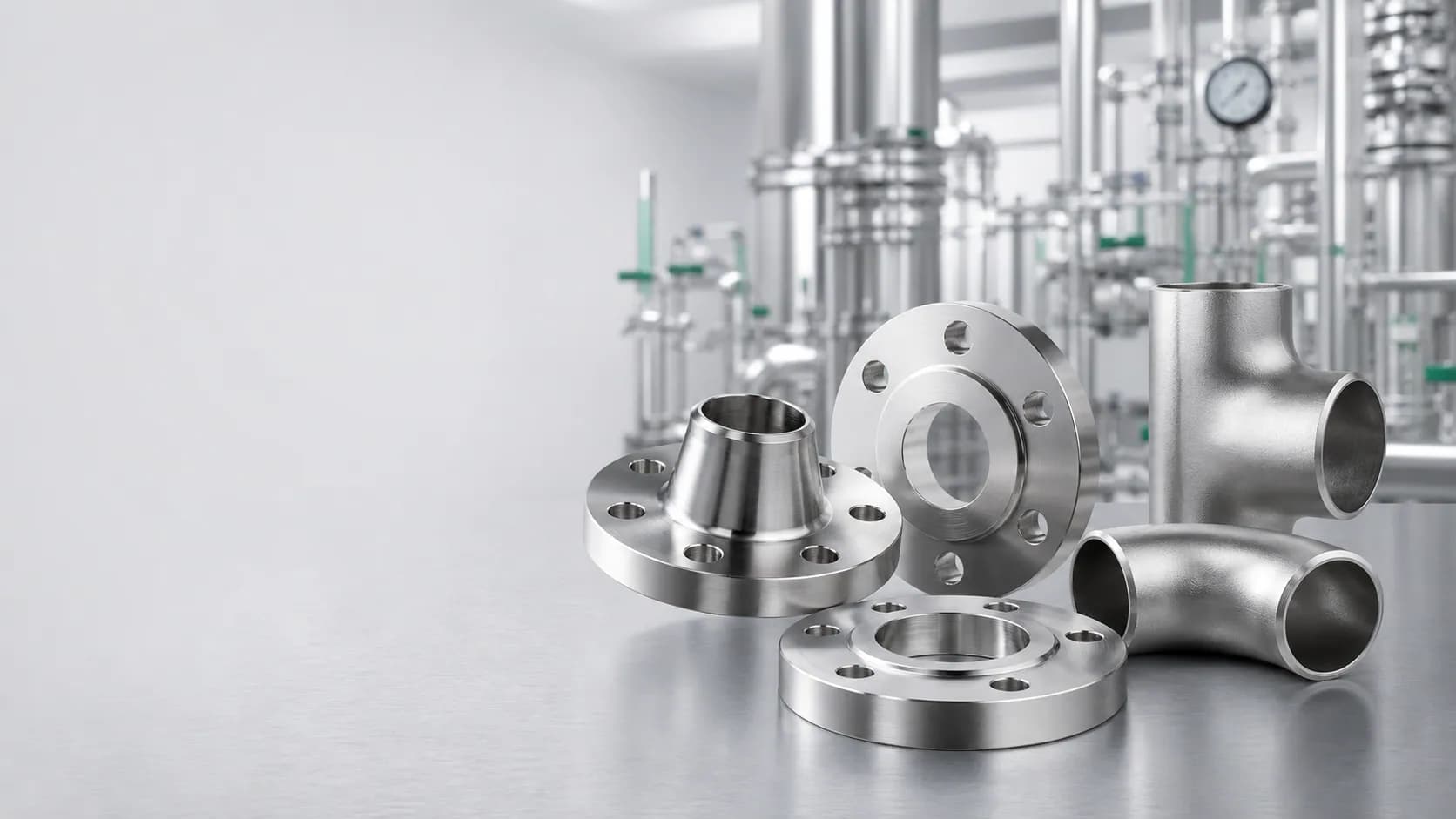
A controlled 316L benchmark page for buyers and materials engineers specifying low-carbon molybdenum-bearing stainless steel flanges and pipe fittings for process, petrochemical, food, pharmaceutical, marine, and general corrosion service. It separates ASTM A182 and A403 supply routes, published chemistry and mechanical references, chloride cautions, IGC review, PMI, MTC, EN 10204 3.1, and RFQ fields.
Quick technical snapshot
The snapshot is published only from controlled structured data. Anything that needs review stays out of the authoritative display.
Chloride SCC threshold
Austenitic stainless steels can be susceptible above about 60 deg C / 140 deg F with tensile stress and chloride exposure
Gas corrosion reference
Published guidance identifies air service up to 850 deg C / 1560 deg F and steam up to 750 deg C / 1380 deg F for the cited material data
Solution annealing reference
1000-1100 deg C / 1830-2010 deg F, rapid cooling in air or water for the cited tube data
| Specification | Verified value | Unit |
|---|---|---|
| UNS | S31603 | - |
| ASTM specifications | ASTM A240, A213, A269, A312, A479, A276, A182, A403The correct standard depends on plate, tube, pipe, bar, forging, flange, or wrought fitting route. | - |
| Alloy family | Low-carbon molybdenum-bearing austenitic stainless steel | - |
| Density | 8.03 | g/cm3 |
| General corrosion characteristics | Molybdenum improves general pitting and crevice corrosion resistance compared with 304/304L; chlorides and stress corrosion require caution | - |
| Temperature considerations | Chloride SCC risk rises above about 60 deg C / 140 deg F; published gas-corrosion guidance differs from pressure design limits | - |
| Typical industries | Chemical, petrochemical, food, pharmaceutical, pulp and paper, marine, heat transfer, general process piping | - |
Products and size range
Each material has its own controlled capability record, giving buyers standard dimensional context before final RFQ specification review.
Standard dimensional coverage, pressure-class architecture, facing options, and bore review.
Standard NPS / DN architecture, fitting geometry, schedule or wall, and end preparation control.
Socket-weld and threaded fitting architecture with class and end-connection review.
| Nominal size | DN | Product | Standard | RFQ review |
|---|---|---|---|---|
| 1/2" | DN 15 | Flange | ASME B16.5 | |
| 3/4" | DN 20 | Flange | ASME B16.5 | |
| 1" | DN 25 | Flange | ASME B16.5 | |
| 1-1/4" | DN 32 | Flange | ASME B16.5 | |
| 1-1/2" | DN 40 | Flange | ASME B16.5 | |
| 2" | DN 50 | Flange | ASME B16.5 | |
| 2-1/2" | DN 65 | Flange | ASME B16.5 | |
| 3" | DN 80 | Flange | ASME B16.5 | |
| 4" | DN 100 | Flange | ASME B16.5 | |
| 5" | DN 125 | Flange | ASME B16.5 | |
| 6" | DN 150 | Flange | ASME B16.5 | |
| 8" | DN 200 | Flange | ASME B16.5 | |
| 10" | DN 250 | Flange | ASME B16.5 | |
| 12" | DN 300 | Flange | ASME B16.5 | |
| 14" | DN 350 | Flange | ASME B16.5 | |
| 16" | DN 400 | Flange | ASME B16.5 | |
| 18" | DN 450 | Flange | ASME B16.5 | |
| 20" | DN 500 | Flange | ASME B16.5 | |
| 22" | DN 550 | Flange | ASME B16.5 | |
| 24" | DN 600 | Flange | ASME B16.5 |
| Nominal size | DN | Product | Standard | RFQ review |
|---|---|---|---|---|
| 1/2" | DN 15 | Butt-weld fitting | ASME B16.9 | |
| 3/4" | DN 20 | Butt-weld fitting | ASME B16.9 | |
| 1" | DN 25 | Butt-weld fitting | ASME B16.9 | |
| 1-1/4" | DN 32 | Butt-weld fitting | ASME B16.9 | |
| 1-1/2" | DN 40 | Butt-weld fitting | ASME B16.9 | |
| 2" | DN 50 | Butt-weld fitting | ASME B16.9 | |
| 2-1/2" | DN 65 | Butt-weld fitting | ASME B16.9 | |
| 3" | DN 80 | Butt-weld fitting | ASME B16.9 | |
| 4" | DN 100 | Butt-weld fitting | ASME B16.9 | |
| 5" | DN 125 | Butt-weld fitting | ASME B16.9 | |
| 6" | DN 150 | Butt-weld fitting | ASME B16.9 | |
| 8" | DN 200 | Butt-weld fitting | ASME B16.9 | |
| 10" | DN 250 | Butt-weld fitting | ASME B16.9 | |
| 12" | DN 300 | Butt-weld fitting | ASME B16.9 | |
| 14" | DN 350 | Butt-weld fitting | ASME B16.9 | |
| 16" | DN 400 | Butt-weld fitting | ASME B16.9 | |
| 18" | DN 450 | Butt-weld fitting | ASME B16.9 | |
| 20" | DN 500 | Butt-weld fitting | ASME B16.9 | |
| 22" | DN 550 | Butt-weld fitting | ASME B16.9 | |
| 24" | DN 600 | Butt-weld fitting | ASME B16.9 | |
| 26" | DN 650 | Butt-weld fitting | ASME B16.9 | |
| 28" | DN 700 | Butt-weld fitting | ASME B16.9 | |
| 30" | DN 750 | Butt-weld fitting | ASME B16.9 | |
| 32" | DN 800 | Butt-weld fitting | ASME B16.9 | |
| 34" | DN 850 | Butt-weld fitting | ASME B16.9 | |
| 36" | DN 900 | Butt-weld fitting | ASME B16.9 | |
| 38" | DN 950 | Butt-weld fitting | ASME B16.9 | |
| 40" | DN 1000 | Butt-weld fitting | ASME B16.9 | |
| 42" | DN 1050 | Butt-weld fitting | ASME B16.9 | |
| 44" | DN 1100 | Butt-weld fitting | ASME B16.9 | |
| 46" | DN 1150 | Butt-weld fitting | ASME B16.9 | |
| 48" | DN 1200 | Butt-weld fitting | ASME B16.9 |
Material overview
The narrative supports specification review without replacing the engineer's design basis, corrosion review, or purchase standard.
Stainless Steel 316L / UNS S31603 is the RTI benchmark for low-carbon molybdenum-bearing austenitic stainless flanges and fittings. It is often the starting point for process piping packages before a move to duplex, super duplex, 904L, 6Mo, or nickel alloy is justified.
The grade is attractive because it combines availability, weldability, corrosion resistance above 304/304L in many environments, and broad ASTM/ASME product-standard coverage. It should not be oversold into hot chloride, severe seawater, or sour-service environments without engineering review.
RTI procurement should capture the product route precisely: A403 for wrought stainless fittings, A182 for forged flanges and forged fittings, A312 for pipe, A213/A269 for tube, and A240/A479/A276 for feedstock or machined-component routes.
Chemical composition
The published chemistry values are structured data and must be reconciled against the actual material certificate for every supplied lot.
| Element | Verified composition | Basis |
|---|---|---|
| Chromium | 16.0-18.0 | Mass % |
| Nickel | 10.0-14.0 | Mass % |
| Molybdenum | 2.00-3.00 | Mass % |
| Manganese | 2.00 max | Mass % |
| Silicon | 0.75 max | Mass % |
| Nitrogen | 0.10 max | Mass % |
| Phosphorus | 0.045 max | Mass % |
| Carbon | 0.030 max | Mass % |
| Sulfur | 0.030 max | Mass % |
| Iron | Balance | Mass % |
Mechanical properties
Mechanical values are presented with product-form context. Flanges and fittings still follow the ordered ASTM or ASME route.
| Product form | Yield / proof strength | Tensile strength | Elongation / hardness |
|---|---|---|---|
| Plate, sheet, strip | 170 MPa / 25 ksi min | 485 MPa / 70 ksi min | 40% min; 95 HRB max |
| Tube and pipe at 20 deg C | >=220 MPa Rp0.2; >=250 MPa Rp1.0 | 515-690 MPa | >=45% A; >=35% A2 in; <=90 HRB |
| Bar at 20 deg C | 205 MPa Rp0.2 min; 240 MPa Rp1.0 min | 515-690 MPa | >=40% elongation; max 215 HBW |
Corrosion behaviour
These notes are intentionally conservative because medium chemistry, temperature, stress, crevices, fabrication, and cleaning practice govern final suitability.
316L has published resistance in many organic acids, selected inorganic-acid ranges, and salt solutions, but contaminants and temperature can change suitability quickly.
Molybdenum improves localized corrosion resistance compared with 304/304L, yet hot chloride and stagnant crevice conditions still require engineering review.
Low carbon content improves resistance to intergranular corrosion after welding compared with higher-carbon 316 variants.
Austenitic 316L remains susceptible to chloride stress corrosion cracking under tensile stress and elevated temperature; duplex grades can be considered where SCC resistance is central.
Available RTI products
The page template separates product form, material route, dimensional standard, inspection, and final release documents.
316L flange enquiries should specify ASTM A182 F316L / ASME SA182 F316L, pressure class, facing, bore, dimensions, marking, MTC, and PMI scope if grade segregation risk exists.
316L elbows, tees, reducers, caps, and stub ends should be reviewed against ASTM A403 WP316L / ASME SA403 WP316L and the appropriate dimensional standard.
Relevant standards
Each enquiry should identify which standard controls the product form, which standard controls dimensions, and which documents prove conformance.
Wrought austenitic stainless steel pressure piping fittings
Forged or rolled stainless steel flanges, forged fittings, valves, and parts
Seamless and welded austenitic stainless pipe reference
Tube reference standards for stainless tubing routes
Plate, sheet, and strip reference
Bar and machined-component feedstock reference
Applications
Applications are signals for engineering review, documentation scope, and grade comparison.
Typical industries
The same grade can behave differently by industry because service media, inspection plans, and owner specifications change.
Quality and inspection
For critical alloys, inspection and certificate requirements belong in the RFQ, not as an afterthought before dispatch.
PMI helps avoid confusion between 304L, 316L, 317L, 904L, duplex, and nickel alloy components in mixed stainless packages.
The MTC should confirm UNS S31603, product form, heat number, chemistry, mechanical values, heat treatment where applicable, and standard/grade marking.
Specify EN 10204 3.1 inspection certificate requirements where buyer QA needs lot-level traceability from the manufacturer.
Third-party inspection can be added for dimensional checks, marking, visual inspection, document review, and packing release.
NACE review should be requested only where sour-service conditions exist; 316L should not be assumed suitable for all sour chloride service.
IGC review or testing may be ordered where welding, heat treatment history, or project specification requires proof against intergranular attack.
Material comparison
This section frames substitution as an engineering decision, especially where corrosion mechanism, temperature, weld route, or code requirements change.
| Comparison | 316L | Alternate route | Procurement consideration |
|---|---|---|---|
| Versus 304L | Molybdenum-bearing 316L improves pitting and crevice resistance over 304L | 304L can be adequate for cleaner, lower-chloride, less aggressive service | Choose 316L where molybdenum-bearing stainless is specified or corrosion margin is needed |
| Versus Super Duplex 2507 | Lower strength and lower chloride SCC resistance, but wider availability and simpler procurement | 2507 is the severe chloride and high-strength upgrade route | Escalate when chloride, temperature, crevice geometry, or SCC risk is material |
| Versus Inconel 625 | Economical austenitic stainless for moderate corrosion requirements | Inconel 625 is a nickel alloy severe-service option | Compare actual process medium, temperature, chloride, concentration, and inspection burden |
Procurement guidance
A strong alloy enquiry names the grade, standard, dimensions, inspection, documentation, packing, and destination before commercial comparison.
01
State UNS S31603 or 316L clearly, then define product route: A403 for wrought fittings, A182 for flanges/forged fittings, A312 for pipe, or A240/A479/A276 for feedstock.
02
Include dimensional standard, pressure class, wall schedule, facing, bore, end type, and quantity in the RFQ.
03
For chloride or seawater exposure, ask engineering whether 316L remains acceptable or whether duplex, super duplex, 904L, 6Mo, or nickel alloy should be reviewed.
04
Specify MTC, EN 10204 3.1, PMI, TPI, visual, dimensional, marking, and packing requirements before commercial comparison.
05
Do not substitute 316L for 316, 317L, 904L, duplex, or super duplex without a written engineering concession.
Engineering FAQs
FAQ content is unique to each benchmark material and remains tied to verified structured guidance.
Related materials
Internal links connect related alloy families, technical guidance, and RFQ preparation.
Related technical guides
These connect material selection to document control, testing, quality review, and RFQ completeness.
Grade and product route review
Inspection and certificate planning
Traceable quotation package
Structured RFQ
Capture material, standard, dimensions, quantity, inspection, documentation, packing, and destination before the technical quotation is prepared.
Technical quotation desk
Send us your material grade, size, class or schedule, quantity, and specification.