
Efficiency-led plant design
Cooling components should fit the selected air-side, water-side, free-cooling, or heat-exchange architecture without adding avoidable pressure loss, maintenance complexity, or material inconsistency.
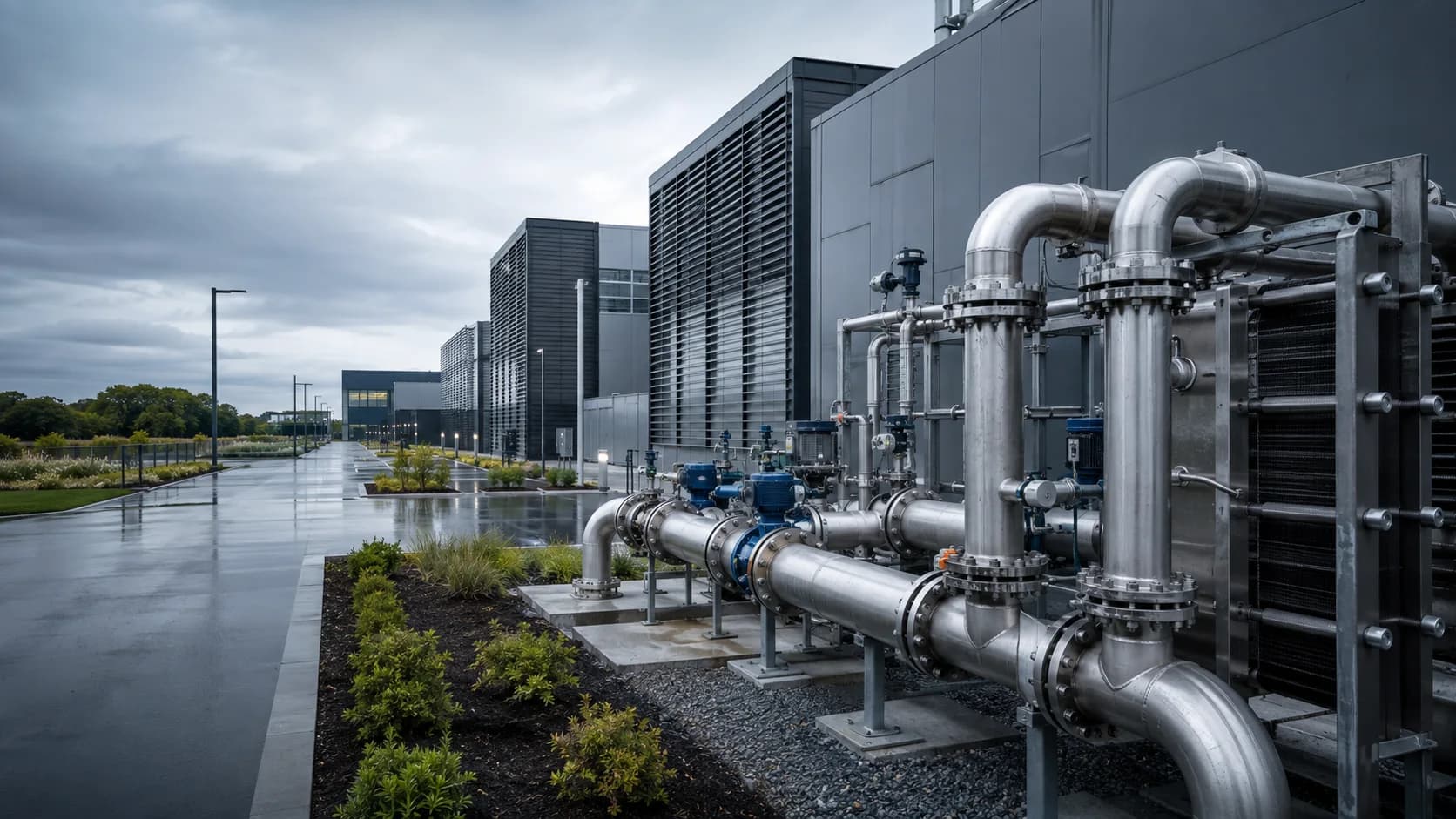
Ireland / Dublin / High-performance data centers
Raymond Tube Industries manufactures and exports stainless steel and duplex flanges and fittings for Dublin data-center mechanical systems, with emphasis on efficient cooling loops, water management, maintainable plant connections, and controlled expansion or retrofit procurement.
Engineering context
Define the operating system, water chemistry, equipment interfaces, dimensional standard, and release documentation before selecting the component route.
Dublin data-center projects place strong attention on cooling efficiency, electrical demand, water strategy, and responsible infrastructure growth. Component procurement should support that operating discipline through durable material selection, maintainable connections, controlled cleanliness, and documentation that remains useful throughout the asset life.
Closed-loop water systems may reduce direct exposure to contaminants, but they still require review of oxygen ingress, treatment chemicals, galvanic interfaces, stagnation, temperature cycling, and commissioning conditions. Stainless Steel 316L is a strong baseline for many corrosion-resistant plant requirements; 304L and Duplex 2205 remain engineering choices tied to the actual circuit.
RTI supports Dublin enquiries as a manufacturer and exporter from India. RTI does not state that it has an office, warehouse, stockyard, or manufacturing facility in Dublin or Ireland. Quotations define the offered scope, documentation, packing, and delivery terms.
Location-specific review
Cooling components should fit the selected air-side, water-side, free-cooling, or heat-exchange architecture without adding avoidable pressure loss, maintenance complexity, or material inconsistency.
Treatment chemistry, make-up frequency, oxygen control, commissioning flushes, and dissimilar-metal interfaces influence the corrosion review even where the loop is nominally closed.
Live campus growth requires accurate interface data, clear isolation strategy, documented material identity, and packaging that supports installation in constrained plant areas.
Data-center applications
Each application carries its own fluid, equipment, inspection, cleanliness, and maintenance context.
Stainless flanges and fittings for low-temperature distribution, pumping, heat exchange, and maintainable equipment connections.
Connections at plate heat exchangers, dry coolers, and hybrid cooling equipment used to improve seasonal efficiency.
Filtration, dosing, sampling, side-stream treatment, make-up, and controlled drain or blowdown assemblies.
Headers, branches, equipment isolation, bypass arrangements, and removable spool connections in central mechanical spaces.
Future tie-ins and modular plant additions where piping-class consistency and phased documentation are important.
Replacement components and reconfigured interfaces for efficiency improvements without implying direct supply to any named facility.
Material priorities
316L, 304L, and Duplex 2205 receive the main procurement focus. Super duplex and nickel alloys remain restricted to explicitly defined specialty services.
Component forms
Product form, material route, dimensions, and inspection must remain explicit throughout the quotation.
Weld neck flanges are commonly reviewed for welded headers and equipment nozzles. Slip-on, blind, socket weld, threaded, and lap-joint forms remain specification-dependent choices for isolation, maintenance, small-bore service, and dissimilar-material transitions.
Review product routeElbows, tees, reducers, caps, and stub ends define direction changes, branch connections, equipment transitions, and removable joints. Socket-weld and threaded forged fittings may be evaluated for smaller utility branches where the piping class permits.
Review product routeStandards
Use the project piping class, equipment drawings, and purchase specification to resolve the final combination.
Use the project piping class to define NPS, class, facing, bore, flange form, and dimensional edition. Pressure class is not a standalone pressure guarantee and must be reconciled with material and temperature.
ASME B16.9Specify fitting geometry, NPS, schedule or wall thickness, end preparation, dimensional edition, and the applicable material product specification for elbows, tees, reducers, caps, and stub ends.
ASME B16.11Socket-weld and threaded fittings require an explicit pressure class, end type, dimensional basis, and material grade. They should follow the approved small-bore piping class rather than a generic substitution.
Inspection and documentation
Define internal cleanliness, end caps, surface condition, packaging, and any passivation documentation needed before commissioning into treated-water systems.
Request the applicable MTC, heat traceability, PMI where specified, and confirmation of the ordered product route for wrought, forged, and fabricated components.
Verify flange facing, drilling, bore, thickness, fitting end preparation, and equipment-interface dimensions before release for retrofit or modular installation.
Procurement controls
State whether the component belongs to a closed chilled-water loop, heat-recovery loop, condenser-water system, dry-cooler circuit, or treatment skid.
Include available chemistry, inhibitor or glycol information, operating temperature, and commissioning conditions for material review.
Attach skid and equipment drawings, nozzle schedules, and tolerance requirements where prefabricated modules meet site piping.
List required certificate format, declarations, inspection plans, marking, packing, and destination documents at RFQ stage.
Buyer FAQs
Answers keep location intent useful without making local-stock, local-facility, or named-project claims.
Engineering links
Data-center component RFQ
Send the circuit, material and UNS, product form, size, class or schedule, facing or end connection, quantity, standards, inspection, documentation, packing, and destination.
Technical quotation desk
Send us your material grade, size, class or schedule, quantity, and specification.